ClearCook parent guide

Wipe-Clean Recipe Cards for Kids: Better Than Printables, Screens or Laminated Sheets?

Quick answer: For regular cooking with children, wipe-clean recipe cards are usually the most practical recipe format. They stay visible, do not need scrolling or unlocking, can be handled with sticky or floury fingers, wipe clean after spills and give children a reusable cooking tool of their own.

Cooking with children can build confidence, independence, reading, maths, motor skills and a proud I made this moment. But it is also messy. Flour lands on paper, sticky fingers tap phones, the screen locks halfway through mixing and suddenly the adult is managing the recipe, the cleaning and the cooking support all at once.

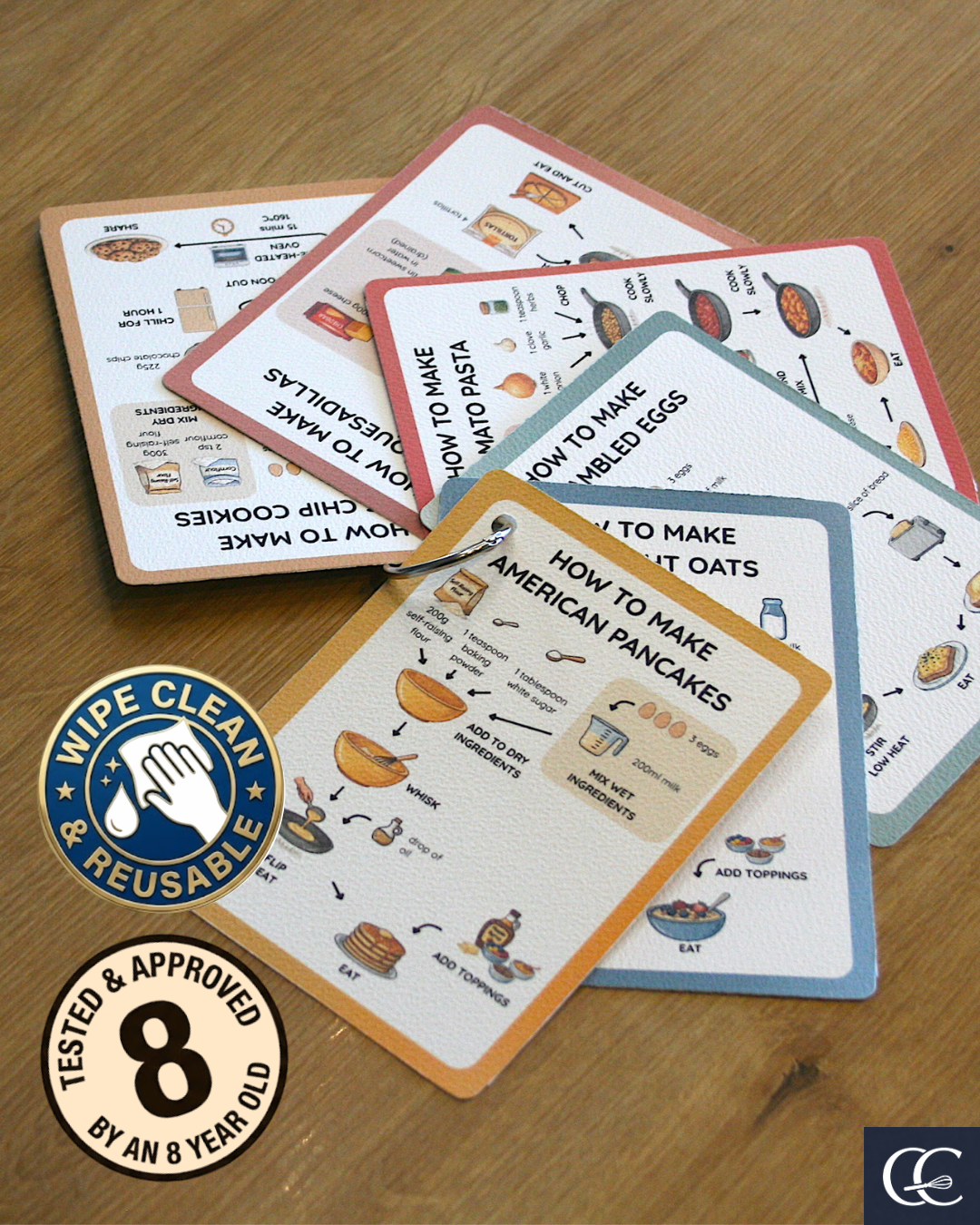
ClearCook wipe-clean recipe cards for kids showing reusable waterproof surface
Wipe-Clean Recipe Cards for Kids: Better Than Printables, Screens or Laminated Sheets? guide illustrated with ClearCook visual recipe card imagery.

Parents often compare four options: a phone or tablet, a printable recipe, a laminated recipe sheet, or a purpose-made wipe-clean recipe card. They can all work, but they do not work equally well once a child is standing at the counter with wet hands, floury sleeves and a bowl that needs stirring now.

The best recipe format for children is one they can see, follow and handle without constant adult help. For occasional use, a phone or printable may be enough. For repeated family cooking, wipe-clean visual recipe cards are often easier because they are visible, reusable, child-friendly and made to survive real kitchen mess.

Why cooking with children gets messy so quickly

Children learn by doing. In the kitchen, that means touching, pouring, stirring, cracking, spreading, sprinkling and tasting. Mess is not a sign that the activity is going wrong; it is often the evidence that the child is actually participating.

The common mess points are predictable: flour on hands and counters, egg or batter splashes, syrup, butter or tomato sauce marks, wet counters near the sink, sticky fingers after fruit or chocolate, and recipe pages getting folded, torn or lost.

None of this means children should not cook. It means the recipe format needs to match the environment. A kitchen recipe for children needs to be more durable than a normal sheet of paper and less distracting than a phone.
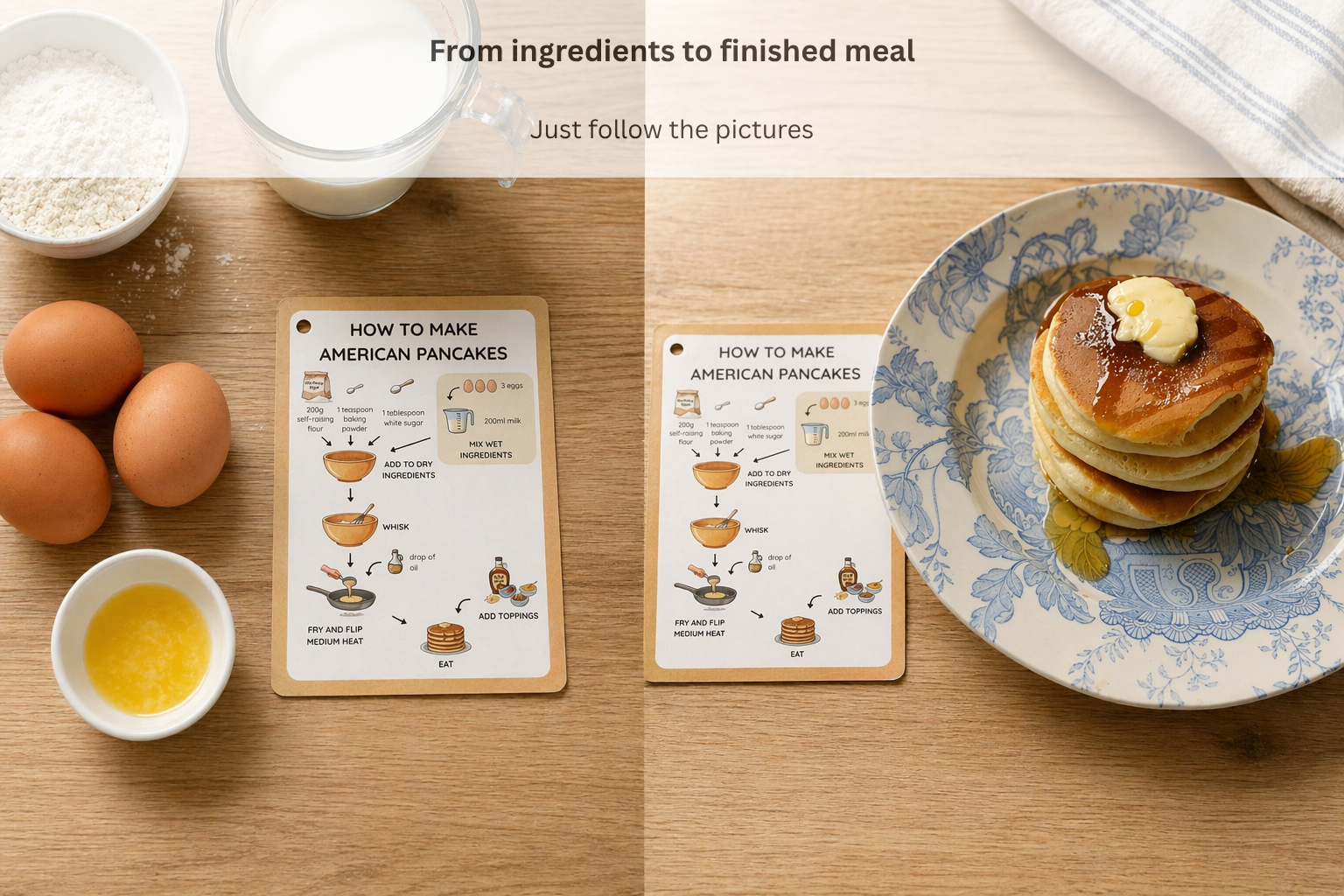
Wipe-clean ClearCook recipe card surface being used in a real kitchen
A wipe-clean card is useful because mess is part of children learning to cook, not a failure of the activity.

Quick comparison: phone, printable, laminated sheet or wipe-clean card

There is no single format that suits every moment. A phone is brilliant for browsing ideas. A printable can be perfect for one rainy-day activity. A laminated sheet can work well if you already print and organise resources. But for regular kids' cooking, the format has to survive use, not just look tidy before you begin.

The table below is the practical parent version: what each format is good at, where it tends to fail and whether it supports child independence during real cooking.

Recipe format
Best for
Main problem
Good for child independence?
Phone or tablet
Searching for recipe ideas, watching videos and helping adults browse quickly.
Screens lock, children need help scrolling, sticky fingers touch the device and notifications can distract from the task.
Sometimes, but it usually keeps the adult in charge of the recipe.
Printed recipe
One-off activities, classrooms, worksheets and trying a recipe cheaply.
Paper gets wet, torn, stained, folded or lost, especially when children cook more than once.
Yes for a single activity, but it is not durable for repeated use.
Laminated sheet
DIY reusable recipes, classrooms and parents who already have a printer and laminator.
It needs printing, laminating and storage, and larger sheets can be awkward on a counter.
Yes, but it can be bulky and still needs parent preparation.
Wipe-clean recipe card
Regular kids' cooking, repeat recipes, child-led cooking and screen-free kitchen routines.
You need somewhere sensible to store the cards so they stay easy to find.
Yes, especially when the card uses visual steps and clear adult-help moments.

Using a phone or tablet for kids' recipes

Phones are the default recipe tool for many adults. They are quick, searchable and full of ideas. If you are looking for an easy kids pancake recipe or a simple lunch children can make, a phone is often the fastest place to start.

But once the child is actually cooking, the phone becomes less ideal. The screen locks halfway through the recipe. Children need help scrolling. Recipe pages can be cluttered with adverts, pop-ups or long introductions. The phone gets sticky, greasy or floury. Notifications break focus. And the child is still using the adult's device rather than their own cooking tool.

Phones work well for finding ideas. They are less good as the recipe format for a child standing at the kitchen counter.

Best use

Use phones for browsing and inspiration; use a visible recipe card when the child is cooking.

Printable recipes for children

Printable recipes feel simple and low-cost. You find a recipe, print it and let the child follow it. They can be especially useful for schools, homeschool activities, themed lessons or one-off baking sessions.

The hidden cost is the admin. Someone has to find the file, print it, trim it, organise it, store it and replace it when it gets ruined. Paper gets wet or stained. Sheets tear or crumple. Ink can smudge. A recipe that was easy at the printer can become frustrating by the sink.

Printables are useful for one-off activities and classroom worksheets. For regular messy cooking at home, they often become another thing for the adult to manage.

Use the online recipes to try a first recipe, then choose physical cards for the ones your child wants to repeat.

Browse free visual recipes

Laminated recipe sheets

Laminated recipe sheets are the classic DIY solution. Parents and teachers print a recipe, laminate it and reuse it. This can work well, especially in classrooms or settings where you already have a laminator and a system for storing resources.

Laminating solves one problem, durability, but it creates another: setup. You need a printer and laminator, sheets can be large and awkward on a counter, corners may peel over time, and the finished resources can be bulky to store.

For a parent who wants something ready to use straight away, laminated sheets can feel like another job on the list.

Why wipe-clean recipe cards are different

Wipe-clean recipe cards are designed for the way children actually cook: hands-on, messy and repeatable. Instead of handing over a phone or printing another sheet, the child can choose a physical card, follow the steps and wipe it clean afterwards.

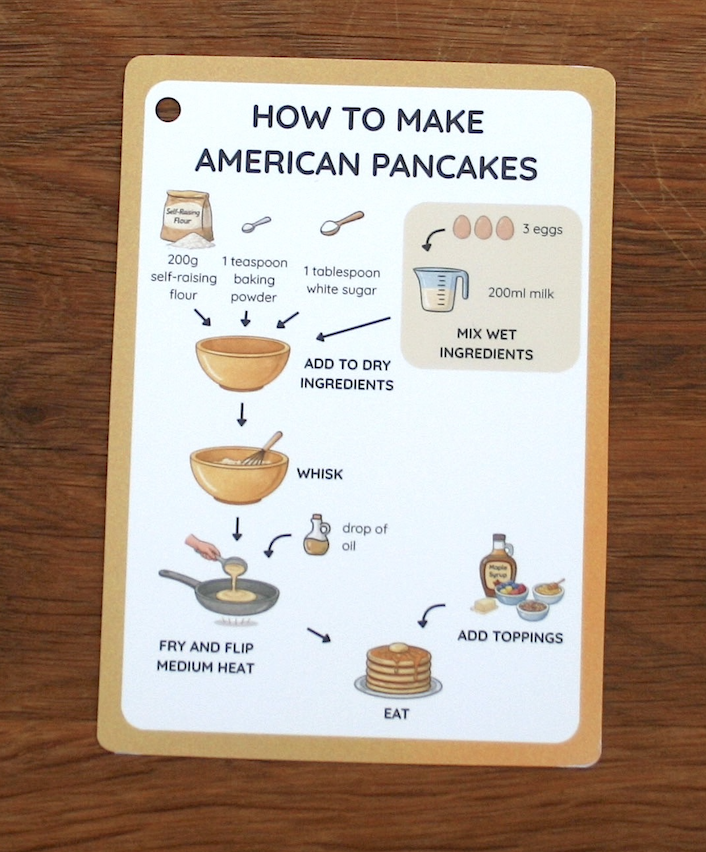
ClearCook cards are designed as A6 visual recipe cards for children. They are waterproof, wipe-clean and tear-resistant, with simple picture-led steps and storage on a binder ring or magnetic fridge hook. The child can hold the card, place it beside the bowl, check the next step and use it again next time.

The biggest advantage is that wipe-clean cards are not just recipes. They are a physical system for helping children cook more independently.

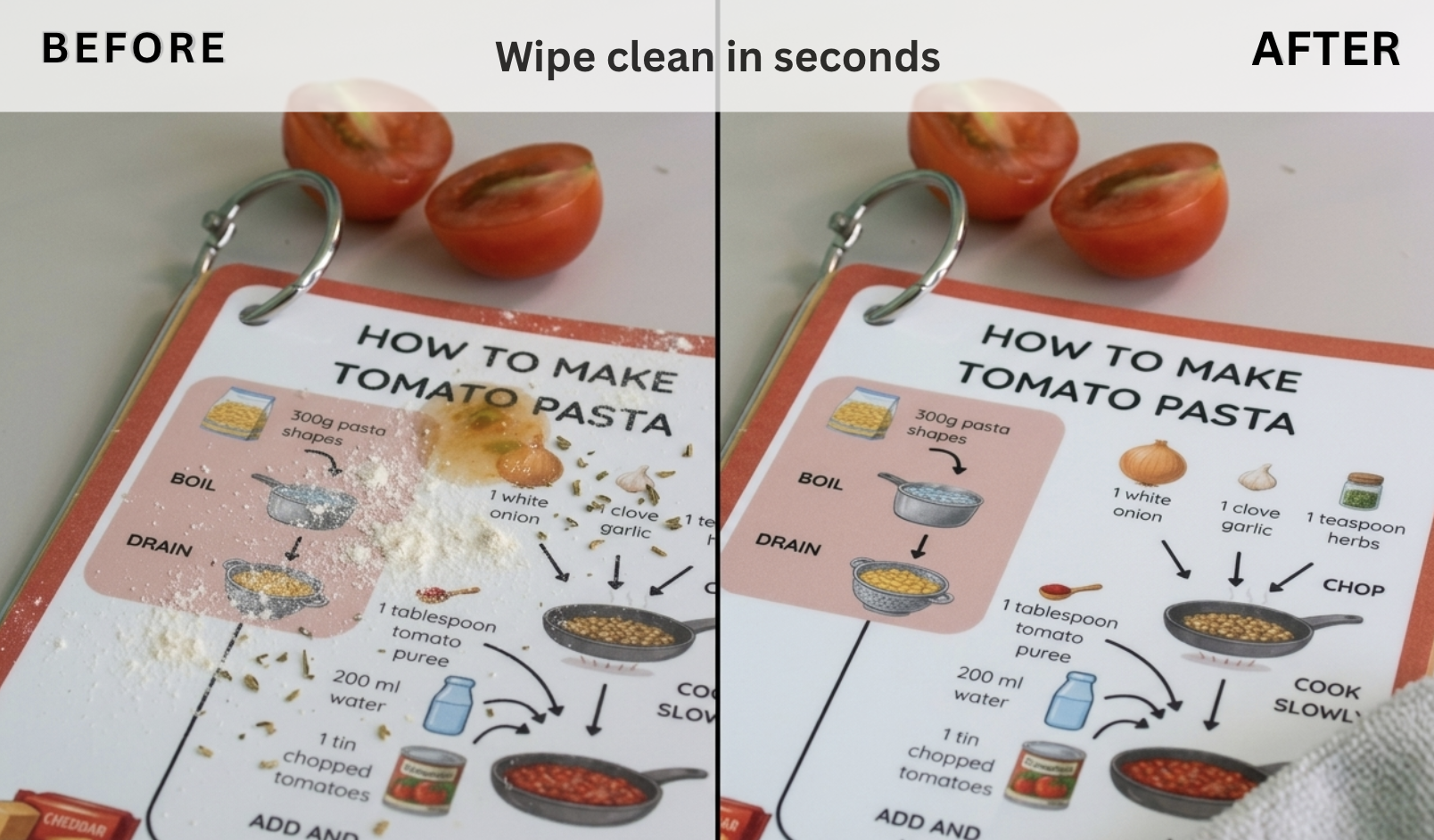
Before and after ClearCook wipe-clean recipe card showing marks removed after cooking
The wipe-clean surface matters because children are more likely to repeat recipes when the materials survive the first attempt.
Advantage
What it means for parents and children
Reusable
The same recipe can come out again next weekend, which helps children build cooking fluency through repetition.
No phone near food
There is no need to unlock, scroll or protect an adult's device from sticky fingers.
Child-friendly size
An A6 card is easier for small hands and crowded counters than a full printed sheet.
Easy to store
A ring or fridge hook keeps recipes visible instead of buried in a folder or drawer.
Visual steps
Pictures help children see the sequence without waiting for every instruction to be read aloud.

Why visual recipe cards help children cook more independently

Children do not always need a long written recipe. In fact, too much text can make cooking feel harder. A child may be able to stir, pour and measure, but still lose their place on a dense recipe page.

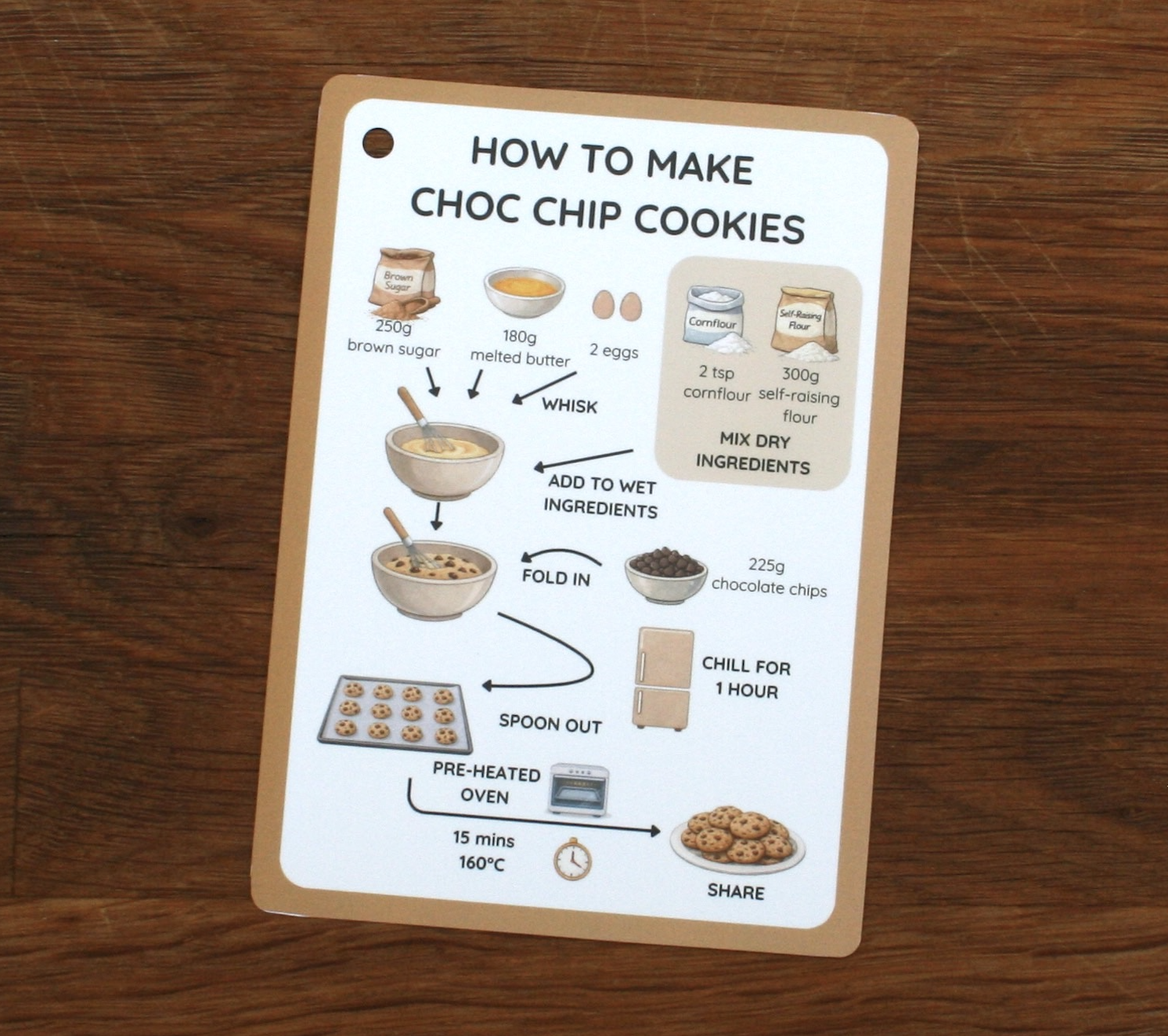
Visual recipe cards break the process into simple steps. A child can see what comes next, understand the sequence and return to the card without needing an adult to keep reading instructions aloud.

This is especially helpful for children who are still building reading confidence, easily distracted, new to cooking, learning routines, more confident with pictures than long text, or keen to do things by myself.

ClearCook Starter Set visual recipe cards for children on a binder ring
A good kids' recipe card should not just tell the child what to do. It should help them feel capable of doing it.

See how picture-led steps help children look, do, check and move on.

Read about visual recipes

Why wipe-clean matters more than parents expect

At first, wipe-clean sounds like a product feature. For family cooking, it is really a behaviour feature.

If the recipe survives the mess, the child can use it again. If it is easy to clean, the parent is more likely to say yes next time. If it hangs on the fridge, the child remembers it exists. If the child can choose it independently, cooking becomes a repeatable habit rather than a special project.

That is the real value of reusable recipe cards: they reduce the friction around cooking with children, not just once, but again and again.

The practical test

If your child cooks a recipe more than once or twice, a reusable wipe-clean format usually becomes more useful than another printed sheet.

How to care for wipe-clean recipe cards

ClearCook cards are designed for real kitchen use, but simple care helps keep them in good condition. Treat the card as part of the closing routine: cook, eat, clean the card and put it back where it belongs.

After cooking, wipe the card with a damp cloth. Use a small amount of washing-up liquid for sticky marks. Dry the card before storing it. Clip it back onto the binder ring or return it to its hook.

Avoid soaking the cards in the sink or putting them in the dishwasher. They are made to be wiped clean, not washed like plates or pans.

After-cooking routine

  • Wipe the card with a damp cloth.
  • Use a little washing-up liquid for sticky marks.
  • Dry the card before storing.
  • Clip it back onto the binder ring.
  • Hang it on the fridge hook or store it somewhere easy to find.

Why fridge storage is useful

Storage sounds like a small detail, but it makes a big difference. When recipe cards are hidden in a drawer, children forget about them. When they are on the fridge, they become part of the kitchen.

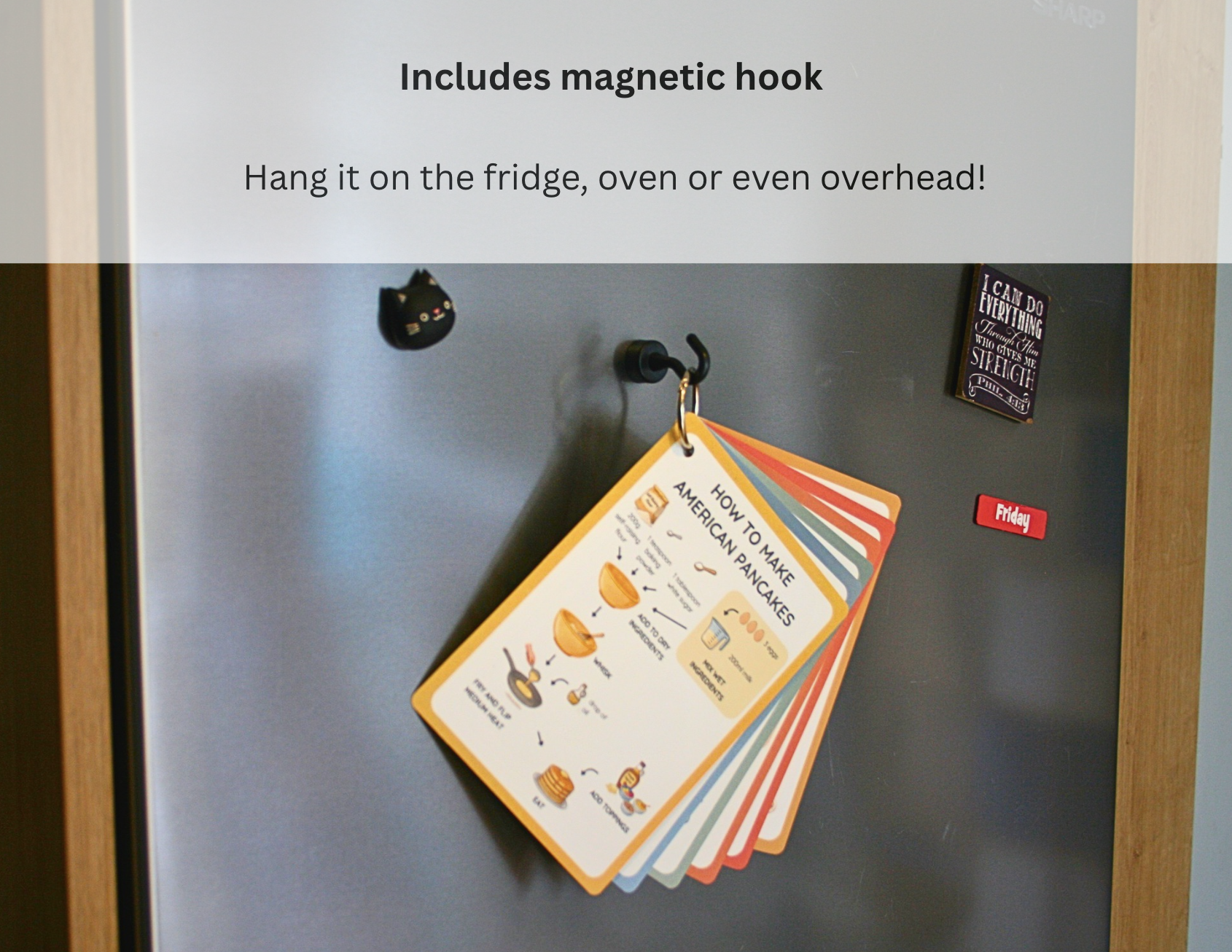
A fridge hook means children can see the recipes available, choose what they want to make, flip through the cards, bring one to the counter and put it back afterwards.

For parents, this means less searching, less printing and fewer where did that recipe go moments. It also supports independence because the child does not need to ask for a phone, log into an app or find a folder. The recipe is already there.

ClearCook wipe-clean recipe cards hanging from a magnetic fridge hook
Visible storage turns recipe cards into an everyday kitchen option, not a resource hidden in a drawer.

Best use cases for wipe-clean kids' recipe cards

Wipe-clean cards are strongest when a recipe is going to be repeated or when the child needs a clear, physical prompt. They work well for first independent recipes, weekend cooking, party bags, classroom packs, clubs and grandparent activities.

Simple recipes such as pancakes, scrambled eggs, overnight oats, quesadillas and cookies are ideal first cards because they are familiar, achievable and satisfying. The adult stays nearby for safety, but the child has a clear structure to follow.

For party bags, a single wipe-clean recipe card can be more useful than sweets or plastic toys. For grandparents, a physical card is easy to understand and does not require finding a recipe online.

Use case
Why wipe-clean cards work well
First independent recipes
The child gets a clear visual sequence while the adult handles safety moments.
Weekend cooking
Children can choose a card from the fridge and make something useful for breakfast, lunch or a snack.
Party bags
A recipe card gives children something to do at home and creates a second moment of enjoyment after the party.
Classrooms and clubs
Reusable cards are more practical than printing the same recipe again and again.
Grandparent activities
A physical card is low-prep, easy to store and does not require searching online.

Use single wipe-clean baking cards as a useful party favour children can cook with later.

See the cookie and cake party bag pack

So, are wipe-clean recipe cards worth it?

Wipe-clean recipe cards are worth it if your child cooks more than once or twice, or if you want them to become more confident in the kitchen.

A printable recipe may be cheaper for a single activity. A phone may be quicker for finding ideas. A laminated sheet may work if you enjoy DIY organisation.

But for repeated children's cooking, reusable wipe-clean cards are usually the most parent-friendly option. They reduce mess, remove screen friction, avoid printing and give children a recipe format they can actually handle.

Explore ClearCook reusable visual recipe cards for kids, from single recipe cards to the Starter Set.

Shop wipe-clean cards

Help your child start with one simple recipe they can make, wipe clean and use again.

Explore the Starter Set

Make progress visible

The Cooking Passport gives children a simple way to mark recipes cooked, skills practised and confidence gained.

Open the Cooking Passport

Free card draws

Enter regular draws for free physical cards

Join the list for card-release news, useful cooking ideas and occasional draws for physical ClearCook cards.

We'll send a ClearCook magic link so you can open the site logged in. Extra ClearCook emails are only sent if you tick the box below.

FAQs

Common questions

What are wipe-clean recipe cards for kids?

Wipe-clean recipe cards for kids are reusable physical recipe cards designed for children to follow while cooking. They usually use simple steps, visual instructions and durable materials that can be wiped after spills or sticky fingerprints.

Are wipe-clean recipe cards better than printable recipes?

For one-off use, printable recipes can work well. For regular cooking, wipe-clean recipe cards are usually more practical because they do not need printing, laminating or replacing after spills.

Are laminated recipe cards the same as wipe-clean cards?

Not exactly. Laminated recipe sheets are usually printed paper sealed in plastic. Purpose-made wipe-clean cards are designed from the start to be handled, stored and reused in the kitchen.

Why not just use a phone for kids' recipes?

Phones are useful for finding recipe ideas, but they are not always ideal for children cooking. Screens lock, children need help scrolling, and phones can get sticky or greasy. A physical card stays visible and does not distract from the cooking task.

What age are kids' recipe cards best for?

They are useful for children who are ready to help with simple kitchen tasks, usually with adult supervision. Younger children may use them as picture prompts, while older children can follow more steps independently.

Can children use recipe cards on their own?

Children should always have the right level of adult supervision in the kitchen, especially around heat, knives and appliances. The aim of visual recipe cards is to help children take more ownership of the steps they can safely do.

How do you clean wipe-clean recipe cards?

Wipe them with a damp cloth after cooking. For sticky marks, use a little washing-up liquid, then dry before storing. Do not soak them or put them in the dishwasher unless the product instructions specifically say to.

What recipes work best on children's recipe cards?

The best recipes are simple, familiar and repeatable: pancakes, overnight oats, scrambled eggs, quesadillas, pasta, jacket potatoes, cookies, banana bread and easy soups.

What are visual recipes?

Visual recipes use pictures, short prompts and clear sequencing so children can follow cooking steps without relying on long written instructions.

What age are ClearCook cards for?

ClearCook is mainly designed for children aged around 4 to 11, with adult support adjusted to the recipe, child and safety risks.

Do children still need adult supervision?

Yes. Children can lead safe jobs, but adults should supervise heat, knives, graters, allergens, heavy equipment and hygiene checks.

Why use wipe-clean cards instead of a phone?

Wipe-clean cards stay visible, do not lock or scroll, and can handle flour, sauce and sticky hands better than a phone in the middle of cooking.