ClearCook parent guide

Cooking Flash Cards for Kids

Quick answer: Cooking flash cards for kids are picture-based prompts that help children understand kitchen actions, ingredients and recipe steps without relying on a long written recipe.

People use the phrases cooking flash cards, recipe cards and visual recipe cards in slightly different ways. For children who want to make real food, visual recipe cards are the clearest fit: they show what to make, what to get out and what to do next.

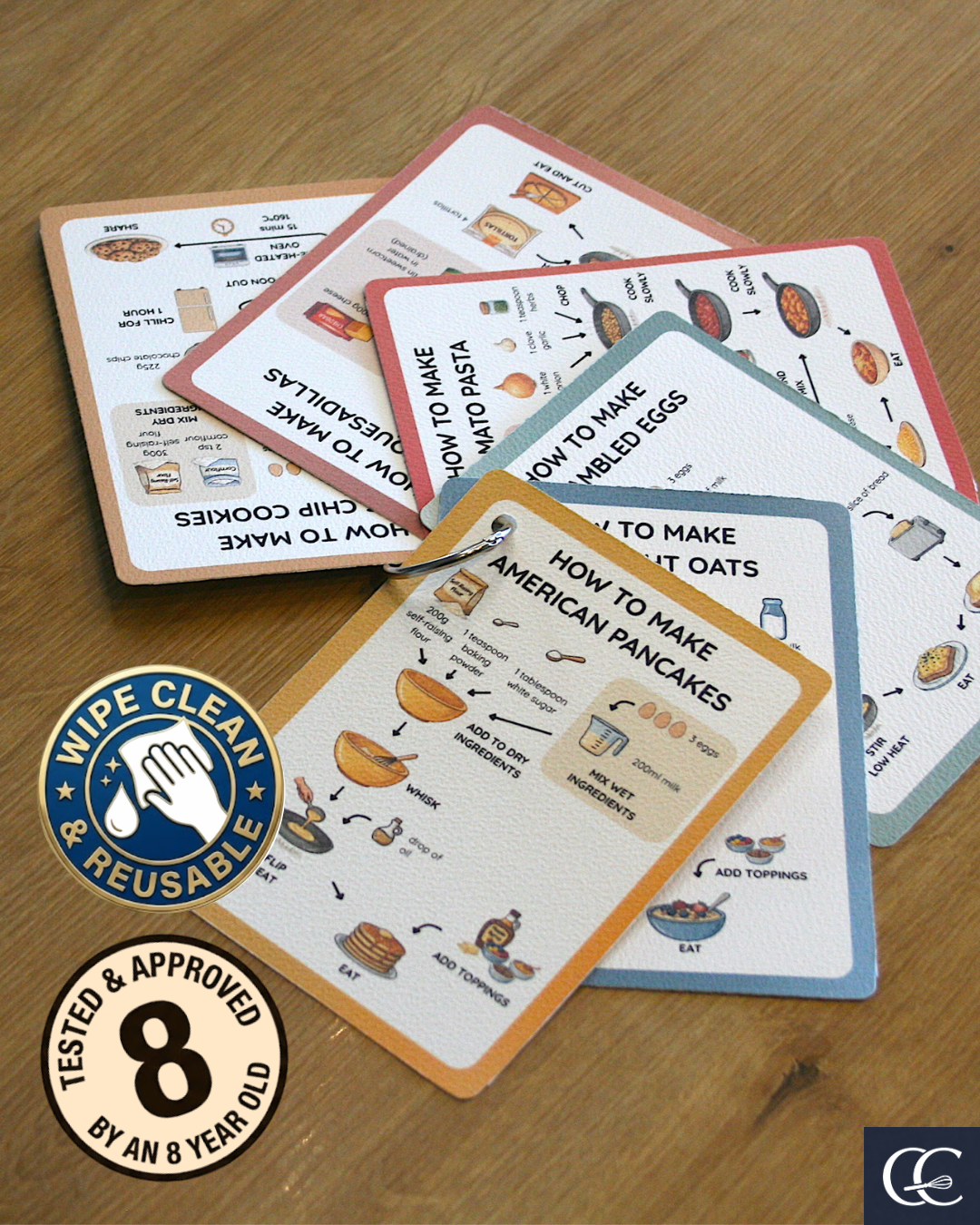
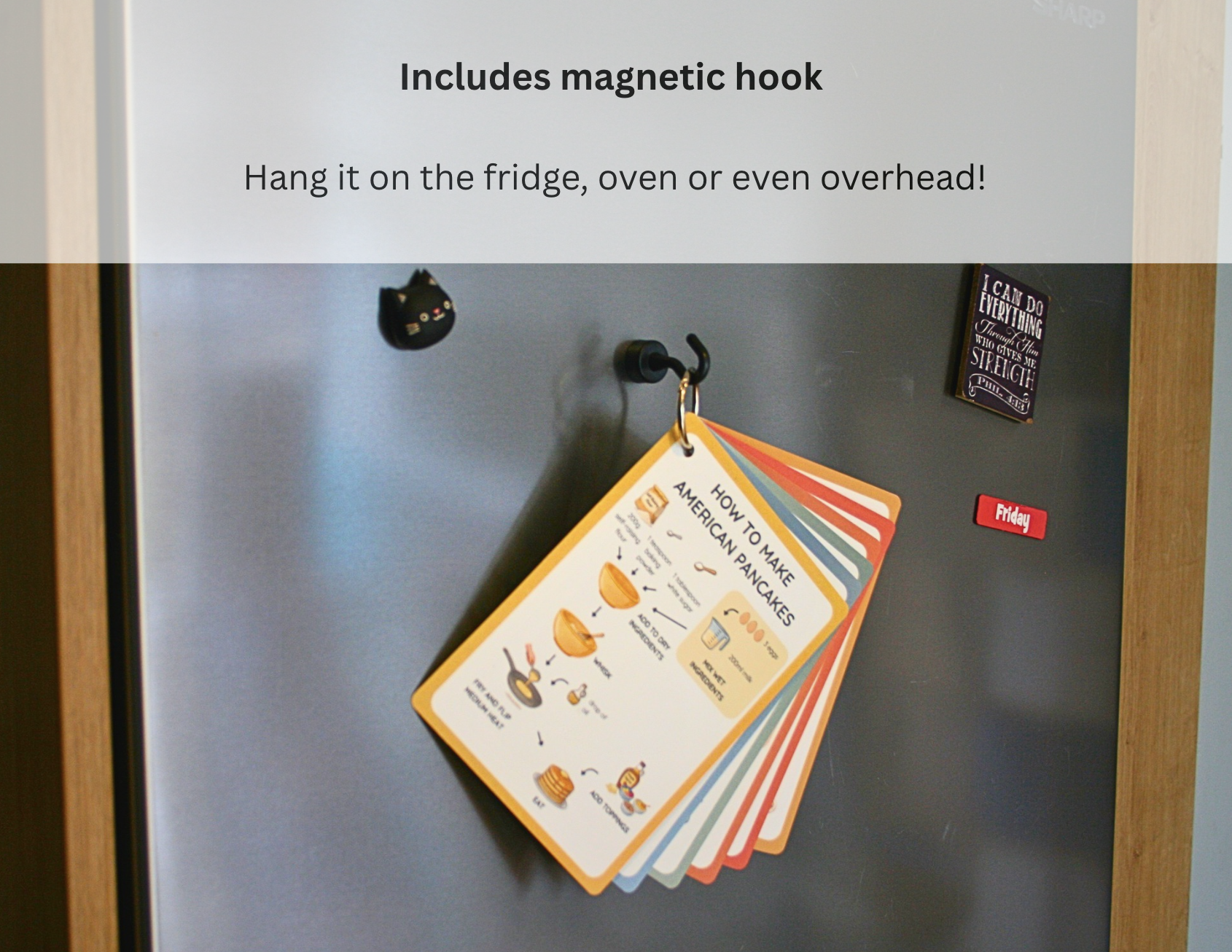
Wipe-clean visual recipe cards for kids hanging on a fridge hook
Cooking Flash Cards for Kids guide illustrated with ClearCook visual recipe card imagery.

Adult recipes can look simple to us and still feel confusing to a child. What comes first? Where does the flour go? How much milk? When do we mix? When do we stop?

Cooking flash cards for kids, also called visual recipe cards or step-by-step cooking cards, break cooking down into small visible prompts. Instead of relying on a long written recipe, children can use pictures, short action words and clear sequencing to understand what to do next.

That visible next step is the whole point. A child does not have to remember everything an adult said two minutes ago. They can look back at the card and carry on.

What are cooking flash cards for kids?

Cooking flash cards are picture-based cards that help children understand kitchen words, tools, ingredients or actions. A card might show mix, pour, whisk, chop or spread. A visual recipe card goes further by putting those actions into the order of a real recipe.

For most families, visual recipe cards is the clearest phrase. It describes exactly what the child is trying to do: follow a recipe using visual steps.

Term
What it usually means
Best use
Cooking flash cards
Cards that teach kitchen words, tools or actions one at a time.
Vocabulary, matching games, speech practice, ESL lessons and classroom activities.
Recipe cards
Cards that contain a recipe, sometimes for adults and sometimes for children.
Keeping a specific recipe handy, especially when the card is written and designed for the right reader.
Visual recipe cards
Step-by-step picture cards showing how to make real food.
Helping children cook more independently because the ingredients, sequence and next action stay visible.
Visual schedules
Picture sequences that show what happens next in a routine.
Supporting transitions and order, such as wash hands, cook, eat and tidy up.
PECS cards
A specific picture-based communication system.
Specialist communication support when designed and used properly; not a general label for recipe cards.

Why visual recipe cards help children cook

Cooking asks children to sequence, listen, measure, wait, notice changes and stay safe. That is a lot to hold in working memory, especially for pre-readers, early readers and children who benefit from visual prompts.

A picture recipe reduces the load. Instead of hearing a whole paragraph and trying to remember it, the child can point to the next picture and do one action.

For parents, the benefit is practical too. Instead of narrating every single step, you can ask, 'What does the card say next?' The card becomes the prompt, not another instruction from an adult.

A small change that matters

An adult recipe might say, 'Combine the flour, egg and milk in a mixing bowl and whisk until smooth.' A child-friendly visual card can show: tip in the flour, crack the egg, pour in the milk, whisk until smooth.

Kitchen words children learn by doing

One hidden benefit of cooking cards is vocabulary. Children learn action words because they see the word, see the picture and do the action at the same time.

Words such as wash, pour, mix, stir, whisk, crack, spread, sprinkle, grate, roll, knead, weigh, measure, bake and serve become practical language, not abstract vocabulary.

Useful prompts while cooking

  • What do we need first?
  • Can you find that picture on the card?
  • What action word can you see?
  • What comes next?
  • How will we know it is finished?

Who visual cooking cards are for

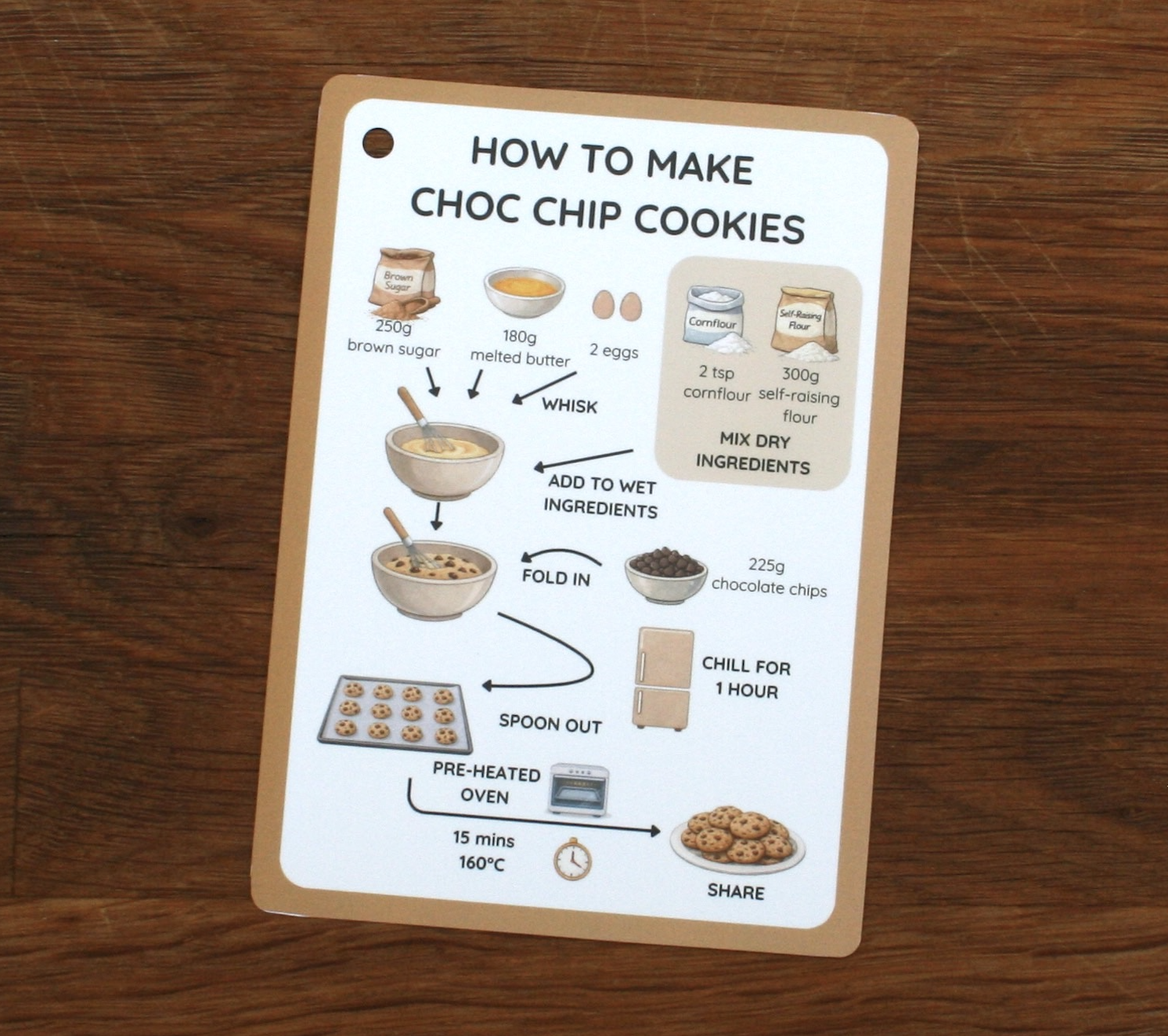
At home, visual recipe cards help children take part in breakfast, snacks, baking and simple meals without needing constant verbal instructions. They work especially well for familiar recipes such as pancakes, scrambled eggs, overnight oats, quesadillas, pasta and cookies.

For children who benefit from visual routines, including some autistic children, children with ADHD, early readers and visual learners, the card can reduce overwhelm by making the activity predictable. It is best described as a visual cooking prompt, not as a clinical intervention.

In classrooms and clubs, cooking flash cards can support kitchen vocabulary, life-skills lessons, food technology, ESL learning, sequencing activities and small-group cooking.

What makes a good first recipe card?

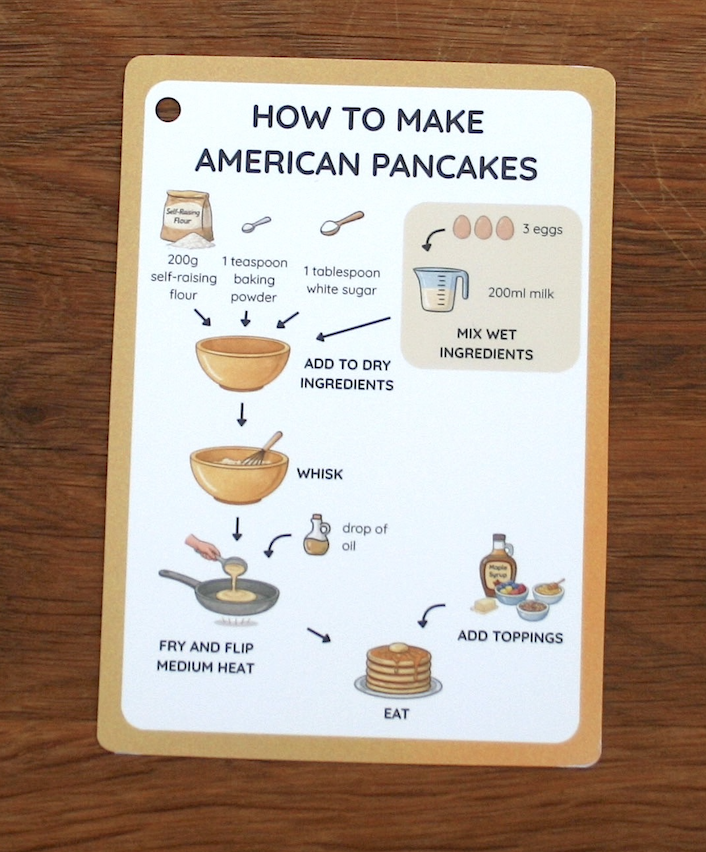
A good first cooking card should be familiar, quick and forgiving. Pancakes are a strong starting point because children can see the recipe change at every stage: flour, egg, milk, mixing, cooking and toppings.

A single recipe card is best if you want to test the idea with one child and one familiar recipe. A starter set is better if you want children to build a habit with choice, repetition and a sense of ownership.

Start with the pancake card, practise it more than once, then add more cards when your child wants choice.

Try one visual recipe card

A single wipe-clean card is a low-pressure way to see whether visual recipe prompts help your child cook with more confidence.

Try one visual recipe card

Make progress visible

The Cooking Passport gives children a simple way to mark recipes cooked, skills practised and confidence gained.

Open the Cooking Passport

Help choose

Vote for the next recipe card

Tell us which cards your family would actually use next, and hear when new ones are released.

We'll send a ClearCook magic link so you can open the site logged in. Marketing emails are only sent if you tick the optional box below.

FAQs

Common questions

What are cooking flash cards for kids?

Cooking flash cards are picture-based cards that help children learn kitchen words, actions and recipe steps. Visual recipe cards go further by helping children follow a real recipe from start to finish.

Are cooking flash cards the same as recipe cards?

They overlap, but flash cards usually teach one word or action at a time. Visual recipe cards show a complete recipe sequence.

Are visual recipe cards good for children who cannot read yet?

Yes. Pictures and simple prompts help children understand the order of a recipe even if they are not confident readers. Adults should still supervise cooking.

Are these the same as PECS cards?

No. PECS is a specific communication system. ClearCook cards are best described as visual recipe cards or step-by-step visual cooking prompts.

Why should recipe cards be wipe-clean?

Cooking is messy. Wipe-clean cards can be handled during real cooking, cleaned afterwards and reused, which makes them more practical than ordinary paper printables.

Can teachers use cooking flash cards in the classroom?

Yes. They can support kitchen vocabulary, sequencing, instruction writing, ESL lessons, food technology and small-group life-skills activities.

What are visual recipes?

Visual recipes use pictures, short prompts and clear sequencing so children can follow cooking steps without relying on long written instructions.

What age are ClearCook cards for?

ClearCook is mainly designed for children aged around 4 to 11, with adult support adjusted to the recipe, child and safety risks.

Do children still need adult supervision?

Yes. Children can lead safe jobs, but adults should supervise heat, knives, graters, allergens, heavy equipment and hygiene checks.

Why use wipe-clean cards instead of a phone?

Wipe-clean cards stay visible, do not lock or scroll, and can handle flour, sauce and sticky hands better than a phone in the middle of cooking.