ClearCook parent guide

Visual Recipe Cards for Children with ADHD Traits

Quick answer: Visual recipe cards can help children with ADHD traits or attention differences by making each cooking step visible. Instead of relying on memory, repeated verbal reminders or long written instructions, the child has a simple visual path to follow: preview the recipe, set up the counter, cook one step at a time and reset afterwards.

Cooking can be brilliant for children. It gives them real responsibility, builds confidence and turns everyday food into something they helped create. But for some children, especially those with ADHD traits or attention differences, cooking can also feel like a lot.

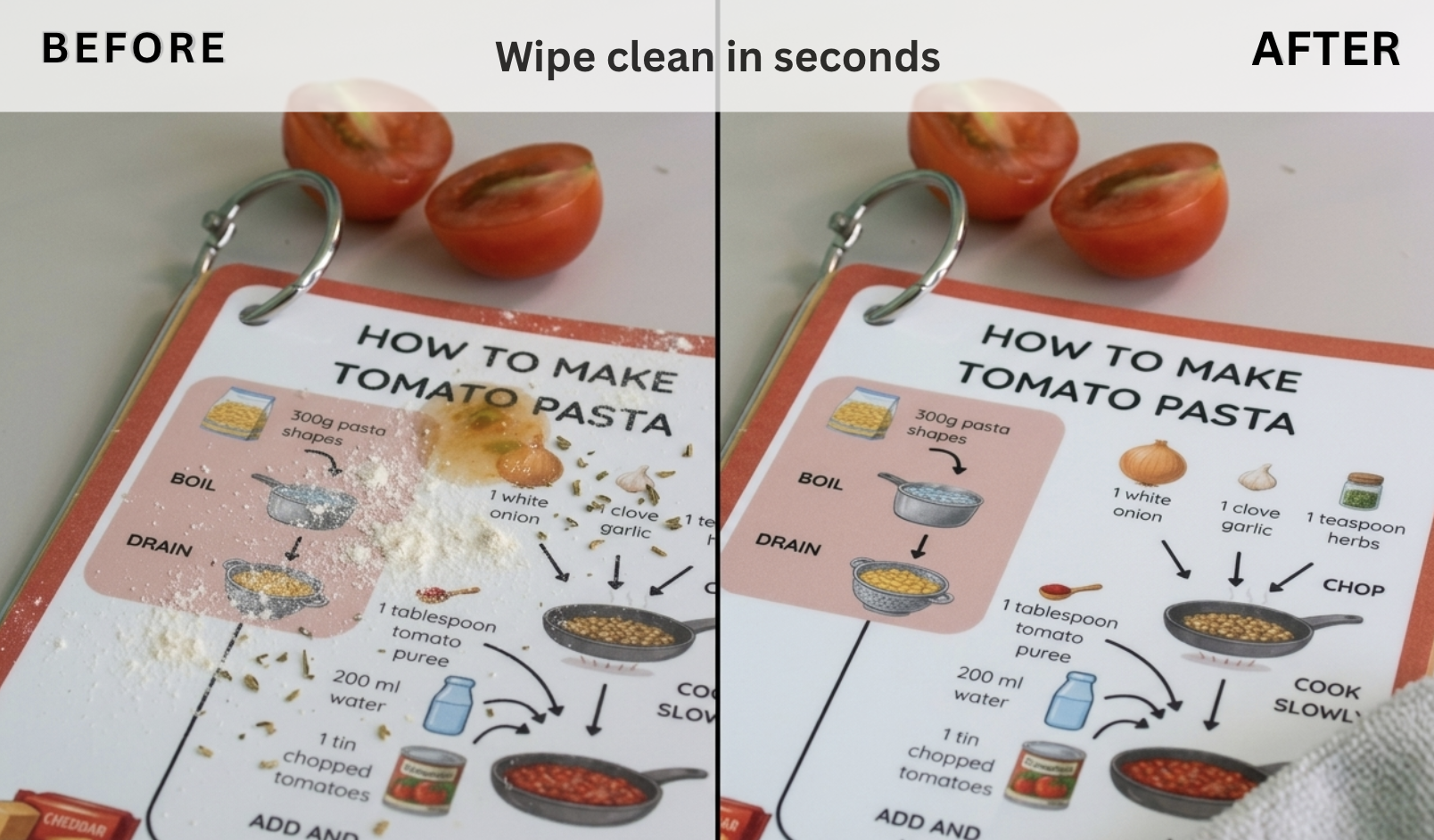
Before and after wipe-clean children's recipe card with cooking steps ticked off
Visual Recipe Cards for Children with ADHD Traits guide illustrated with ClearCook visual recipe card imagery.

There are instructions to remember, ingredients to find, hot things to avoid, timers to wait for and mess to manage. A child may start enthusiastically, then lose their place, skip ahead, touch something impulsively or wander off halfway through.

That does not mean they cannot cook. It usually means the task needs to be made more visible, more predictable and easier to follow one step at a time. This is practical parenting advice, not medical advice. Every child is different, and children using knives, heat or electrical equipment should always be supervised appropriately.

Why cooking can feel hard for children with ADHD traits

Cooking looks simple to adults because we have practised the hidden steps for years. We know how to gather ingredients, keep track of what has already gone in the bowl, wait for the oven, notice when something is boiling and clean as we go.

For children, those hidden steps can be demanding. A recipe might ask them to remember the next instruction, wait while something cooks, move from one stage to another, ignore distractions on the counter, resist touching tools too quickly, notice when something is hot and tidy up after the exciting part is finished.

The aim is not to make cooking perfectly quiet or controlled. The aim is to reduce the load so the child can succeed.

A good cooking routine answers four questions

What are we making? What do I need first? What do I do next? How do I finish and reset?
What are visual recipe cards?

Visual recipe cards are simple cooking instructions shown with pictures, icons, short phrases or tick boxes. They are designed to be easier to scan than a traditional recipe.

A child does not need to hold every step in their memory. They can look back at the card, check where they are and move to the next action.

A strong visual recipe card usually includes a clear picture of the finished food, ingredients shown visually, short step-by-step instructions, one action per step, safety prompts where needed, a way to mark progress and a clean-up reminder at the end.

Before and after wipe-clean children's recipe card with cooking steps ticked off
Wipe-clean cards can be marked during cooking, cleaned afterwards and reused the next time the same routine helps.

Use careful, everyday language

Parents searching for support may use terms like ADHD cooking, ADHD child cooking, visual supports for ADHD or help my child follow recipes. It is useful for a page to include those search terms naturally, but the wording should stay respectful and non-clinical.

Safer phrases include children with ADHD traits, children with attention differences, children who find multi-step tasks tricky, children who need help remembering the next step, children who benefit from visual routines and children who find waiting or transitions difficult.

Avoid language that sounds blaming or diagnostic, such as bad behaviour in the kitchen, fix ADHD cooking problems, ADHD-proof your child or stop impulsive children from making mistakes. A helpful tone is calm, specific and practical.

The four-stage cooking routine: preview, set up, cook, reset

A simple routine can make cooking feel less chaotic. Rather than treating the recipe as one big task, split it into four predictable stages.

Preview means looking at the card before touching ingredients. Ask what are we making, how many steps are there, which parts need adult help, is there waiting time and what does the finished food look like.

Set up means gathering only what is needed: ingredients on one side, tools in the middle, used items on the other side, a bowl for rubbish, a timer where the child can see it and the visual recipe card in a clear place.

Cook means one step at a time. Reset means turning off heat, moving hot items safely, putting rubbish away, wiping the counter and marking the recipe complete.

Stage
What it does
Parent prompt
Preview
Shows the child the finished food, number of steps, waiting time and adult-help moments before the activity begins.
Let's look at the whole recipe first. Then we'll do one step at a time.
Set up
Turns the counter into a visual map so the child can see what is needed now and what has already been used.
Everything we need is here. When we use something, we'll move it to this side.
Cook
Keeps instructions short and uses the card as the main prompt instead of repeated verbal reminders.
Check the card. What comes next?
Reset
Makes cleaning up part of the recipe rather than a difficult surprise transition.
The recipe finishes when the counter is reset.

A simple kids cooking checklist

A checklist can make the routine visible. You can use it as a printed page, a wipe-clean routine card or a verbal pattern you repeat each time you cook.

Preview: look at the recipe picture, count the steps, spot adult-help steps and check waiting time. Set up: wash hands, put the recipe card where you can see it, get ingredients, get tools and clear the counter.

Cook: do one step at a time, tick each step, use the timer, ask before touching heat or knives, and pause before moving on. Reset: turn off heat, put rubbish away, put tools in the sink, wipe the counter and mark the recipe complete.

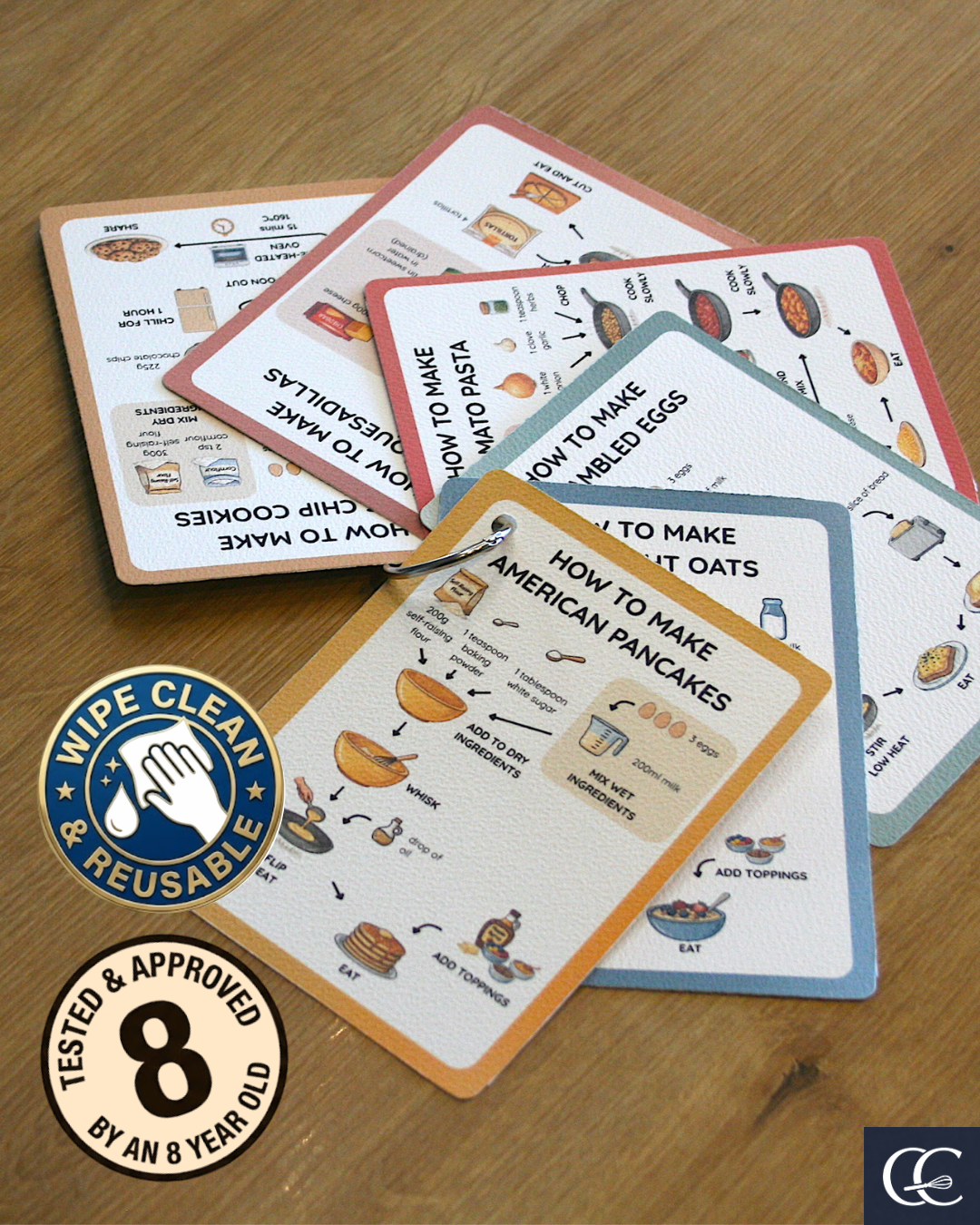
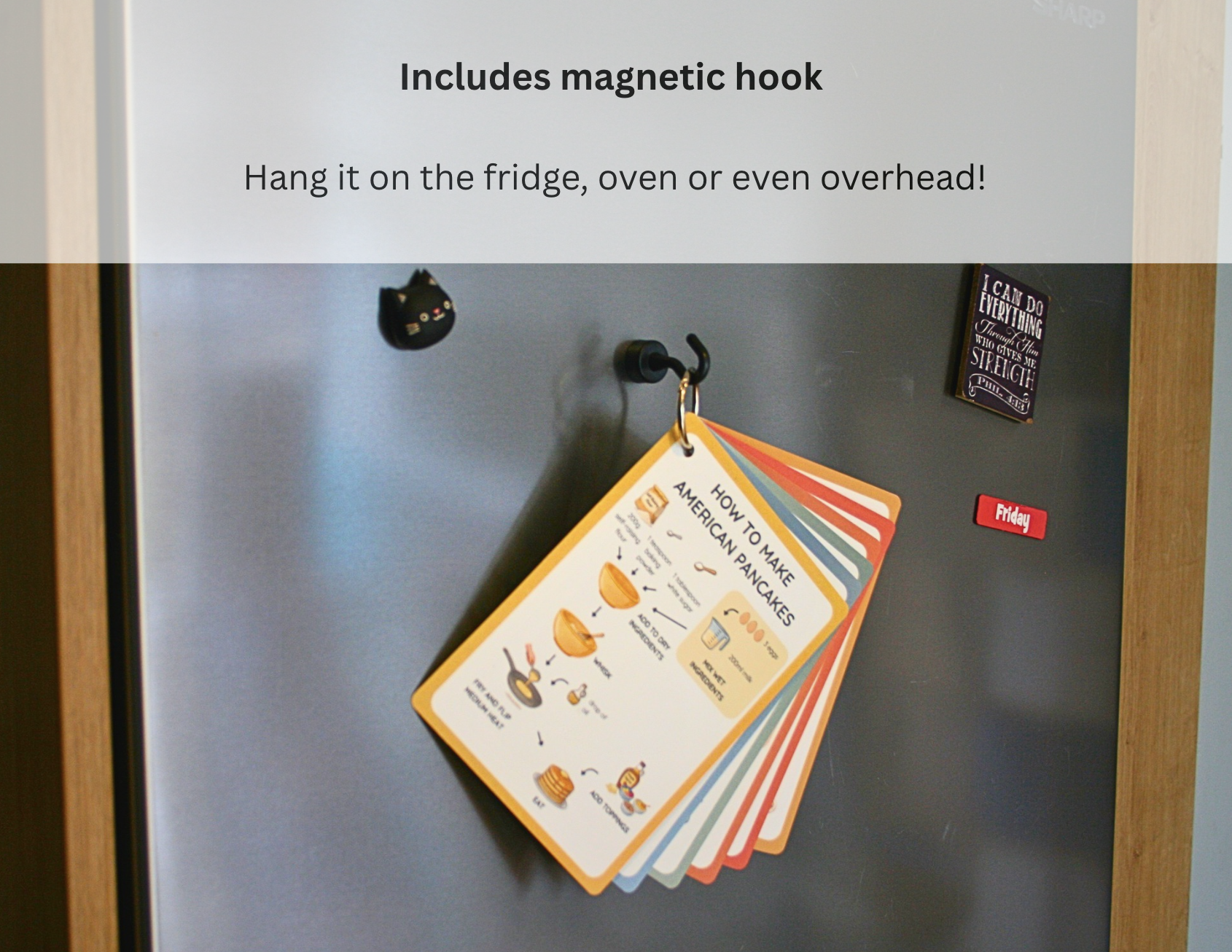
ClearCook visual recipe cards hanging in the kitchen where children can check the next step
Keeping the card visible means the child can return to the process instead of relying only on reminders.

Kids cooking checklist

  • Preview: picture, steps, adult-help moments and waiting time.
  • Set up: hands, card, ingredients, tools and clear counter.
  • Cook: one step, tick it, timer, ask before heat or knives.
  • Reset: heat off, rubbish away, tools in sink, counter wiped, recipe complete.

Why timers help with waiting

Waiting is one of the hardest parts of cooking. A child might ask is it ready every few seconds, open the oven, touch food too early or leave the room and forget to come back.

A timer makes waiting visible. You can use a kitchen timer, phone timer, visual countdown timer, sand timer, oven timer or a while-we-wait mini task card.

For example, while pancakes cook, the child could put away one ingredient, choose a topping, set plates on the table, wipe a small area of the counter or check the next step. This turns waiting into a short, structured activity rather than empty time.

Choose short recipes first

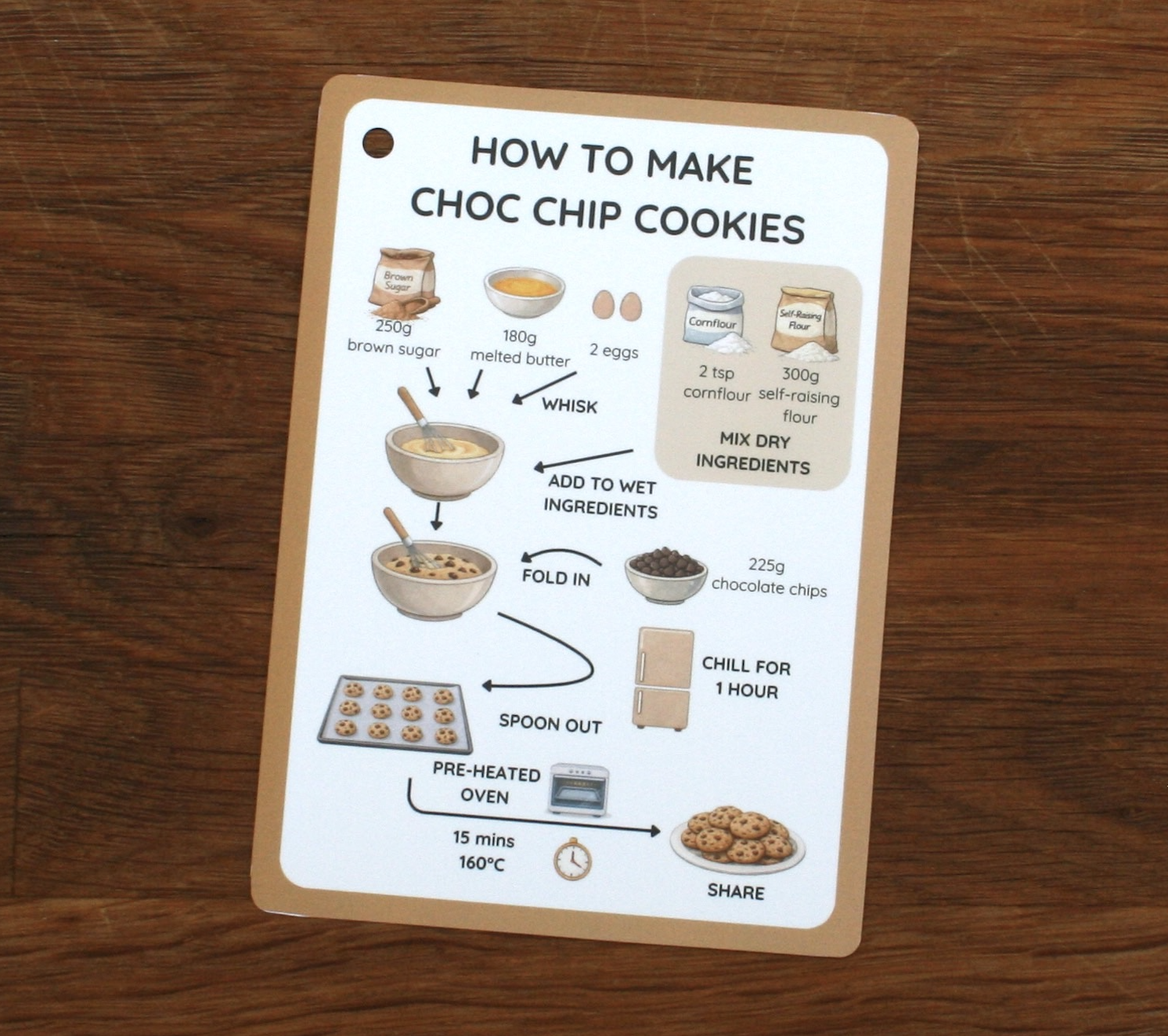
When building cooking confidence, start small. Good first recipes include pancakes, scrambled eggs, overnight oats, cheese quesadillas, jacket potatoes, rice salad with pouch rice, banana bread, simple cookies and homemade soup with pre-chopped vegetables.

Short recipes work well because they have fewer transitions and less waiting. A child can experience the whole cycle: preview, set up, cook and reset. That sense of completion matters. It helps the child feel: I can do this.

Once the routine is familiar, you can gradually add more complex recipes.

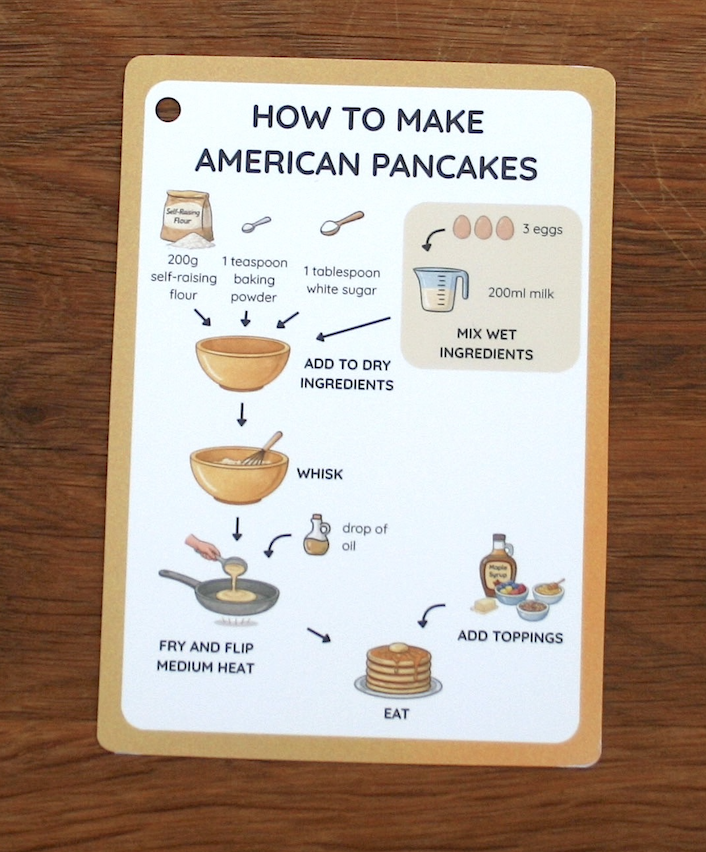
Pancakes are a strong first visual recipe because children can measure and whisk before the adult-led hot pan step.

Start with pancakes

Set up the counter to reduce clutter

A busy kitchen can be distracting. Before you start, remove anything that is not part of the recipe.

Try creating three zones: an ingredients zone for everything needed, an action zone for the bowl or main tool, and a finished zone for used ingredients, rubbish or completed parts.

This makes progress visible. It also reduces the chance of adding the same ingredient twice or forgetting what has already been done. For children who like to move quickly, add a simple rule: only touch what is in the action zone.

Zone
What goes there
Why it helps
Ingredients zone
Everything needed for the recipe, grouped before cooking starts.
The child can see what is needed first without searching through the whole kitchen.
Action zone
The bowl, pan, chopping board or main tool being used right now.
It narrows attention to the current step.
Finished zone
Used ingredients, rubbish or completed parts.
It shows progress and reduces double-adding or skipped steps.

How visual recipe cards support independence

Visual cards do not replace adult supervision. But they can shift the parent's role.

Without a visual card, the parent often becomes the recipe, the timer, the safety reminder and the memory aid all at once. With a visual card, the parent can point the child back to the next step.

Instead of saying now add the flour, no not that, wait, I already told you, don't skip ahead, you can say: look at step three. What does it show? That small change matters. The child is learning to check the process themselves.

Wipe-clean ClearCook visual recipe cards for children who benefit from visible cooking steps
ClearCook cards are designed to sit on the counter or hang nearby while the child checks each step.

Safety still comes first

Visual supports are helpful, but they are not a substitute for supervision. Children should have clear rules around knives and sharp tools, hot pans, ovens and hobs, electrical appliances, raw meat, eggs or fish, hand washing, allergies and cleaning up spills.

A good recipe card should mark adult-help steps clearly: ask an adult before using the oven, adult help for chopping, hot pan do not touch, wash hands after touching raw egg, stop and check before turning on heat.

The adult should decide which steps are safe for the child in front of them today.

Use the safety guide to plan adult-help moments before cooking starts.

Read kitchen safety guidance

A gentle way to start this week

Choose one short recipe. Put the card somewhere visible. Clear the counter. Use a timer. Keep the routine the same each time: preview, set up, cook, reset.

Do not aim for perfect cooking. Aim for one successful step more than last time. For some children, success might be reading the first step. For another, it might be waiting for the timer. For another, it might be wiping the counter at the end.

Small wins build confidence.

Use the Passport to mark completed recipes, track new skills and make progress feel visible.

Open the Cooking Passport

How ClearCook visual recipe cards can help

ClearCook cards are designed to make cooking easier for children to follow independently, with simple visual steps, wipe-clean surfaces and child-friendly routines.

They are especially useful for families who want fewer repeated instructions, clearer cooking steps, a calmer kitchen routine, simple recipes children can follow, reusable cards that can be ticked off and wiped clean, and a way to build confidence over time.

Use them on the counter, clip them to a ring, or hang them where your child can see the steps while they cook. Pair the recipe cards with a Cooking Passport to celebrate progress, track new skills and make cooking feel achievable.

ClearCook starter set of wipe-clean visual recipe cards for children
Start with one simple recipe your child can cook this week, then repeat the same routine until it feels familiar.

Choose one card or a starter set to make the recipe visible, repeatable and easier to follow.

Explore visual recipe cards

Start with one short recipe, one visible card and one achievable job. Build from there.

Try one simple recipe

Make progress visible

The Cooking Passport gives children a simple way to mark recipes cooked, skills practised and confidence gained.

Open the Cooking Passport

New cards

Hear first about new cards

Get a short note when new ClearCook wipe-clean cards and useful family cooking resources are released.

We'll send a ClearCook magic link so you can open the site logged in. Extra ClearCook emails are only sent if you tick the box below.

FAQs

Common questions

Are visual recipe cards good for children with ADHD?

Visual recipe cards may help children who find multi-step tasks, remembering instructions or staying on track difficult. They make each step visible, which can reduce the need to hold the whole recipe in memory. They are not a treatment for ADHD, but they can be a useful practical support at home.

How do I cook with a child who forgets recipe steps?

Use one-step instructions, a visible checklist and tick boxes. Keep the recipe card in front of the child and prompt them to check the next step rather than relying only on verbal reminders.

What are the best first recipes for children who struggle with focus?

Start with short, familiar recipes such as pancakes, scrambled eggs, overnight oats, quesadillas, cookies or banana bread. Choose recipes with fewer ingredients, clear steps and short waiting times.

How can I make cooking safer for an impulsive child?

Set clear safety rules before cooking starts. Mark adult-help steps on the recipe card, keep sharp or hot tools out of reach until needed, clear the counter, and supervise closely around heat, knives and electrical equipment.

Why are timers useful when cooking with children?

Timers make waiting visible. They help children understand how long is left and can reduce repeated questions or impulsive checking. During waiting time, give the child a small job such as setting plates out or wiping the counter.

What should a children's cooking routine include?

A simple routine can include four stages: preview the recipe, set up the counter, cook one step at a time, and reset the kitchen afterwards. Keeping the order the same helps children know what to expect.

What are visual recipes?

Visual recipes use pictures, short prompts and clear sequencing so children can follow cooking steps without relying on long written instructions.

What age are ClearCook cards for?

ClearCook is mainly designed for children aged around 4 to 11, with adult support adjusted to the recipe, child and safety risks.

Do children still need adult supervision?

Yes. Children can lead safe jobs, but adults should supervise heat, knives, graters, allergens, heavy equipment and hygiene checks.

Why use wipe-clean cards instead of a phone?

Wipe-clean cards stay visible, do not lock or scroll, and can handle flour, sauce and sticky hands better than a phone in the middle of cooking.