Mac and Cheese

A picture-led stovetop mac and cheese for kids, with a smooth homemade cheddar and Parmesan sauce.

MediumAges 7-11Adult help needed30 minMakes 4 portionsKids' score 5/5

Prep 10 min · Cook 20 min

Mark as cooked
Share this recipe
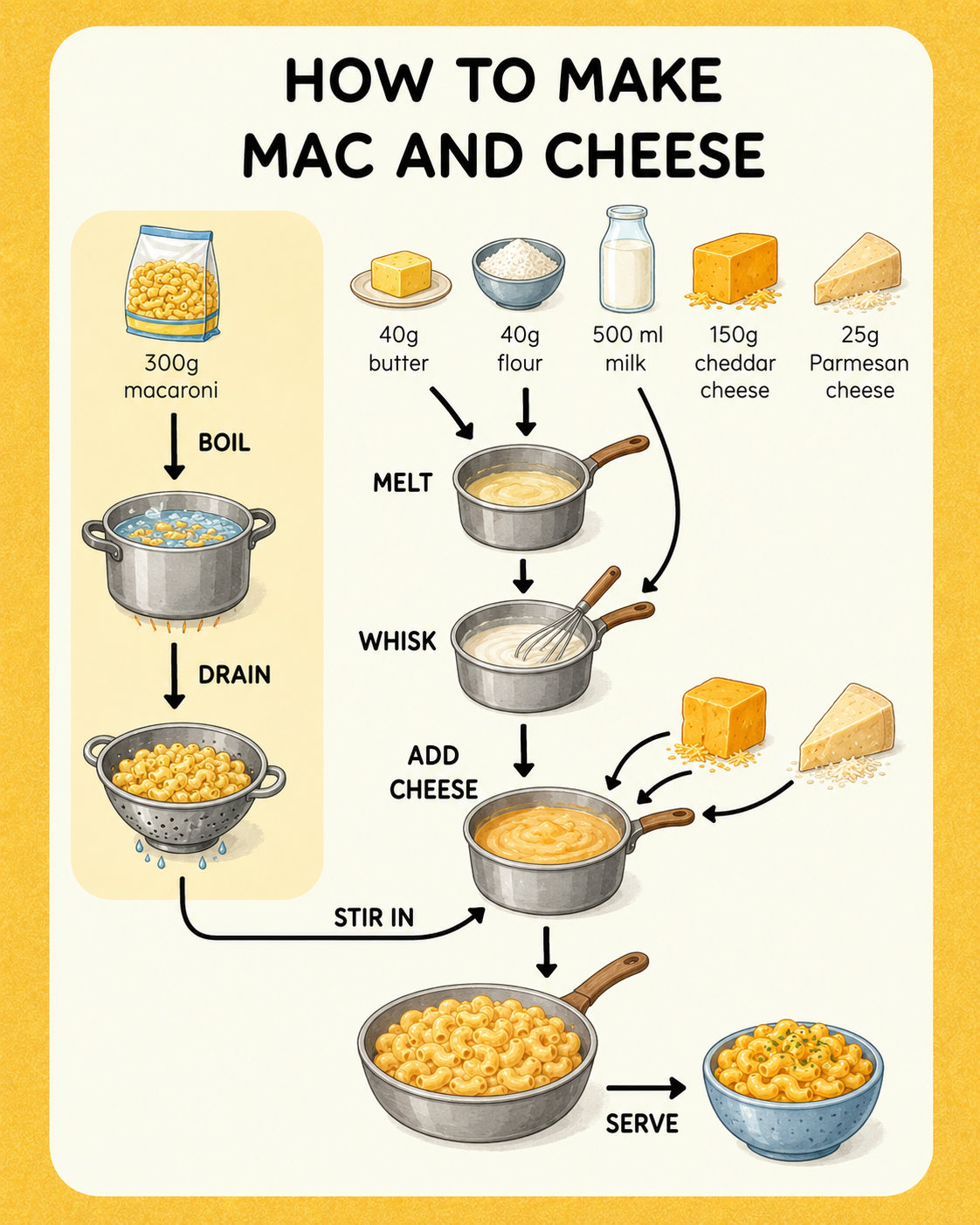
Visual mac and cheese recipe card showing macaroni being boiled and stirred into a cheddar and Parmesan sauce.
Picture-led Mac and Cheese recipe card for children.

For grown-ups

Ingredients

AmountIngredient
300 gmacaroni
40 gbutter
40 gplain flour
500 mlmilk
150 gcheddar cheesegrated
25 gParmesan cheesefinely grated

Equipment

  • Kitchen scales
  • Measuring jug
  • Cheese grater
  • Large saucepan
  • Medium saucepan
  • Colander
  • Wooden spoon
  • Balloon whisk
  • Heatproof spoon or spatula
  • Oven gloves

Step-by-step written method

1

Get everything ready

Weigh 300g macaroni, 40g butter and 40g flour. Measure 500ml milk, grate 150g cheddar and finely grate 25g Parmesan.

Child-friendly: Weigh and measure. Grate both cheeses.

Safety: Supervise the grater and keep fingertips away from its surface.

Tip: Finish grating before the sauce goes on the hob.

2

Boil the macaroni

Adult help

Cook 300g macaroni in a large saucepan of boiling water for the packet time, until tender with a little bite.

Child-friendly: Boil the macaroni for the packet time.

Safety: Boiling water and steam need close adult supervision.

Tip: Set a timer and stir carefully once or twice.

3

Drain the macaroni

Adult help

An adult should drain the cooked macaroni carefully into a colander, then leave it nearby while the sauce is finished.

Child-friendly: Ask an adult to drain the macaroni.

Safety: The full saucepan is heavy and releases burning steam when tipped.

Tip: Do not rinse the pasta; its surface helps sauce cling.

4

Make the butter and flour paste

Adult help

Melt 40g butter in a medium saucepan over low-to-medium heat. Stir in 40g flour and cook for 1 to 2 minutes until smooth and softly bubbling without browning.

Child-friendly: Melt the butter. Stir in the flour.

Safety: The saucepan and butter are hot; keep the handle turned inward.

Tip: Cooking the paste removes the raw flour taste.

5

Whisk in the milk

Adult help

Add 500ml milk a small splash at a time at first, whisking completely smooth after each addition. Once half is mixed in, pour the rest gradually while whisking.

Child-friendly: Add a little milk. Whisk smooth. Keep going.

Safety: Whisk low in the pan so hot sauce does not splash.

Tip: If lumps appear, stop pouring and whisk off the heat.

6

Thicken the sauce

Adult help

Cook for 4 to 6 minutes over gentle heat, stirring across the bottom and into the corners, until steaming and thick enough to coat the back of a spoon.

Child-friendly: Stir until the sauce coats a spoon.

Safety: Steam and thick sauce can burn; stay beside the pan.

Tip: If a finger drawn through sauce on the spoon leaves a clear line, it is thick enough. An adult should handle this hot check.

7

Add the cheese

Adult help

Turn the heat to its lowest setting or move the pan off the heat. Add the cheddar and Parmesan a handful at a time, stirring only until melted and smooth.

Child-friendly: Add both cheeses. Stir until smooth.

Safety: Do not taste from or touch the hot saucepan.

Tip: Gentle heat stops the cheese turning oily or grainy.

8

Stir in the macaroni

Adult help

Fold the drained macaroni through the cheese sauce until every piece is coated. Add a small splash of milk if the sauce is too thick.

Child-friendly: Add the macaroni. Stir it into the sauce.

Safety: Fold slowly so thick hot sauce stays inside the pan.

Tip: The sauce should look slightly loose because pasta absorbs it.

9

Serve

Spoon the mac and cheese into bowls and serve promptly. Check the middle of each child's portion has cooled enough to eat.

Child-friendly: Serve and enjoy!

Safety: Thick cheese sauce holds heat longer than it looks.

Tip: Mac and cheese is creamiest straight from the pan.

Why this works well for children

Mac and cheese works especially well as a teaching recipe because the child can watch one sauce move through three distinct textures: a buttery flour paste, a white sauce that coats a spoon and a glossy cheese sauce. Slow milk additions reward patience, whisking gives children an active job, and folding in macaroni provides a satisfying finish they can recognise immediately. The adult boundary is easy to explain before starting: the adult drains boiling water and remains beside the child while both saucepans are hot.

How to make this one go smoothly

Grate the cheddar and Parmesan and measure the milk before turning on the hob. Once butter and flour meet, the sauce benefits from steady attention, so this preparation prevents a child having to rush between a hot pan and the grater.

Cook the macaroni according to its packet because shape and brand affect timing. Aim for tender pasta with a little bite: it will soften slightly more when folded through the hot sauce. The adult-led draining stage is a useful pause before everyone returns to the sauce.

Let the butter melt without browning, then stir in flour until no dry patches remain. Cook this paste for 1 to 2 minutes so the finished sauce does not taste floury. It should bubble softly and smell a little biscuity, not turn dark.

Treat the first milk additions as a series of tiny experiments. Each splash briefly makes the paste look thicker; whisking then turns it smooth again. Once the sauce loosens, children can pour more steadily, but somebody should keep the whisk reaching the pan's edges and base.

The white sauce is ready for cheese when it steams and leaves a clear coating on the back of a spoon. If it is watery, cook it for another minute; if it is very stiff, whisk in a splash of milk. Lower the heat before cheese goes in and never chase faster melting with a hard boil.

Fold in macaroni rather than beating it, then decide immediately whether the sauce needs a final splash of milk. It should look a little looser in the pan than on the plate because pasta continues drinking it in. Serve promptly and cool children's portions before eating.

What kids can do independently

  • Weighing
  • measuring
  • grating
  • boiling
  • draining
  • melting
  • making a roux
  • gradual pouring
  • whisking
  • judging sauce thickness
  • melting cheese gently
  • folding pasta through sauce

These are the child-led jobs to offer first. Keep the adult jobs separate, then hand over one small task at a time so the recipe still feels calm.

Nutrition information

Calories
620 kcal
Protein
27g
Carbohydrates
68g
Fat
27g
Fibre
3g
Sugar
7g
Salt
0.9g

Allergens, swaps and storage

Contains or may contain: gluten, dairy. Always check packet labels before cooking.

Simple substitutions usually work best when they keep the same texture and cooking time. Store leftovers safely once cool and follow normal food hygiene guidance.

What adults should supervise

Name the two-pan moment before starting. While macaroni boils and sauce thickens, the child should have one clear standing position with handles turned away from the edge. The adult drains the macaroni and controls any moment when attention would otherwise be split between pans.

Whisking is useful child-led work, but hot sauce can splash if the whisk is lifted or flicked. Model small circles that stay against the pan base, and share the milk pouring so the child never has to whisk, pour and monitor the heat simultaneously.

The finished sauce looks calm but holds heat extremely well. Move the saucepan to a stable, heatproof spot, serve with a deep spoon and check the centre of each portion. Leftovers need prompt cooling rather than sitting in the warm pan while everyone eats.

  • Supervise the cheese grater and use a stable work surface. Grate into a wide bowl so children do not chase small cheese blocks close to the sharp holes.
  • An adult should lift and drain the large macaroni saucepan. Keep children clear of the sink because both boiling water and rising steam can burn.
  • Stay beside the child while butter melts and flour cooks. Turn the handle inward and keep the heat moderate so the paste bubbles rather than spits or browns.
  • Support gradual milk pouring. Adding too much at once creates lumps; useful adult help is pausing the pour while the child whisks the mixture completely smooth.
  • Show children how to whisk against the base without lifting and flicking hot sauce. Take over briefly if the pan begins sliding or the sauce catches in the corners.
  • Lower the heat before cheese is added. Boiling at this stage can make the sauce grainy, so move the pan off the heat temporarily if it remains too fierce.
  • Macaroni, flour, butter, milk, cheddar and Parmesan mean this recipe contains gluten and milk. Check every alternative label and avoid cross-contact for anyone with an allergy.
  • Cool leftovers and refrigerate within 2 hours, eat within 48 hours and reheat only once until steaming hot throughout.

Parent FAQ

Is mac and cheese a good recipe for children to make?

Yes, because the sauce changes visibly at every stage and gives children an immediate result for careful whisking. Weighing, grating and stirring are satisfying jobs, while an adult can take over draining and stay close at the hob. It suits children ready to slow down and add milk gradually rather than tip everything in at once.

What can children do independently?

Children can weigh the macaroni, butter, flour and cheeses, measure milk, grate with supervision and stir cheese into the thickened sauce. A confident child can whisk while an adult pours the milk, or the roles can be reversed. The adult should lift and drain the pasta saucepan.

How do I stop the cheese sauce becoming lumpy?

Add only a small splash of milk to the butter-and-flour paste at first, then whisk until completely smooth before the next splash. If lumps appear, stop pouring, take the pan off the heat and whisk firmly around the edges and base. Once the mixture is smooth and loose, return it to gentle heat and continue.

Why has my cheese sauce become grainy or oily?

Cheese can tighten and release oil when it is boiled or heated too aggressively. Lower the heat or move the pan off it before adding cheddar and Parmesan, then stir in one handful at a time only until melted. A small splash of milk and gentle whisking may rescue a sauce that has just begun to split.

Can I use different pasta or cheese?

Any small pasta shape that holds sauce can replace macaroni, but follow its own packet cooking time. A good melting cheddar provides most of the smoothness, while Parmesan adds savoury flavour; another hard cheese can replace Parmesan if needed. Check labels because dairy-free cheeses vary greatly in salt, allergens and melting behaviour.

How should leftovers be stored and reheated?

Cool leftovers promptly, cover and refrigerate within 2 hours, then eat within 48 hours. Reheat only once until steaming hot throughout, stirring in a splash of milk because the macaroni will absorb sauce in the fridge. Stir well to remove cold pockets and let a child's portion cool before eating.

ClearCook Cooking Passport

Cooked it?

Mark this recipe as done and add it to your ClearCook Passport — a private record of every meal cooked.

View passport