Banana Bread

Picture-led banana bread for kids, made with ripe bananas and a simple one-bowl method.

EasyAges 6-10Adult help needed75 minMakes 10 slicesKids' score 5/5

Prep 15 min · Cook 50 min

Mark as cooked
Share this recipe
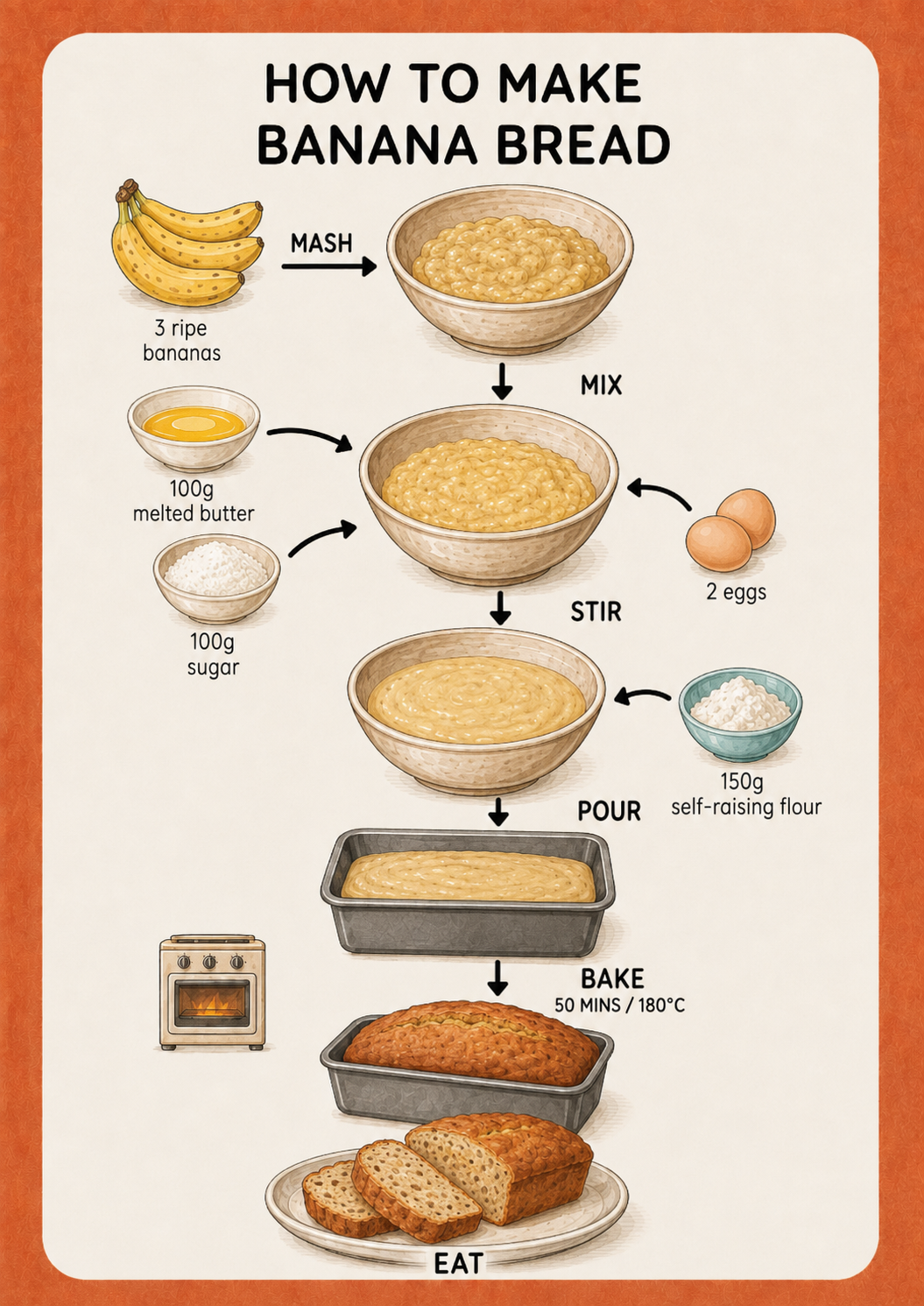
Visual banana bread recipe card showing bananas mashed, mixed and baked into a loaf.
Picture-led Banana Bread recipe card for children.

For grown-ups

Ingredients

AmountIngredient
3ripe bananasabout 300g peeled
100 gbuttermelted and cooled slightly, plus a little for greasing
100 gsugar
2eggs
150 gself-raising flour

Equipment

  • 2lb (900g) loaf tin
  • Baking paper
  • Large mixing bowl
  • Small cup
  • Fork or potato masher
  • Wooden spoon or spatula
  • Kitchen scales
  • Small saucepan or microwave-safe bowl
  • Skewer
  • Oven gloves
  • Cooling rack

Step-by-step written method

1

Prepare the oven and tin

Adult help

Heat the oven to 180C (160C fan). Grease and line a 2lb (900g) loaf tin, leaving paper above the long sides.

Child-friendly: Line the loaf tin.

Safety: An adult should switch on the oven and explain which surfaces will become hot.

Tip: Paper handles make the cooled loaf easier to lift.

2

Mash the bananas

Peel 3 ripe bananas into a large bowl. Mash with a fork or potato masher until mostly smooth; a few small lumps are fine.

Child-friendly: Peel and mash 3 bananas.

Safety: Keep the bowl stable so the masher cannot slip.

Tip: A damp cloth under the bowl stops it travelling.

3

Mix the wet ingredients

Adult help

Add 100g melted butter that has cooled slightly, 100g sugar and 2 eggs. Mix until evenly combined.

Child-friendly: Mix in butter, sugar and eggs.

Safety: An adult should melt and check the butter; wash hands after raw egg.

Tip: Crack each egg into a cup first.

4

Fold in the flour

Add 150g self-raising flour. Fold slowly, scraping the bottom and sides, just until no dry flour remains.

Child-friendly: Add flour. Fold gently.

Safety: Begin slowly so flour stays in the bowl.

Tip: Stop as soon as the last white streak disappears.

5

Fill the tin

Scrape the batter into the lined loaf tin and spread it gently into the corners. Level the top with the back of the spoon.

Child-friendly: Pour into the tin. Smooth the top.

Safety: Keep hands away from the heating oven.

Tip: Scrape the bowl so the loaf keeps the card quantities.

6

Bake the loaf

Adult help

An adult should bake the loaf for about 50 minutes. It is ready when risen and golden and a skewer from the centre has no wet batter.

Child-friendly: Ask an adult to bake for 50 minutes.

Safety: Only an adult with dry oven gloves should handle the oven, tin and skewer test.

Tip: If needed, bake 5 minutes more and retest.

7

Cool and serve

Adult help

Cool in the tin for 10 minutes. An adult should lift the loaf onto a rack using the paper; cool completely, then slice into 10 pieces.

Child-friendly: Cool completely. Slice and eat.

Safety: The tin stays hot and an adult should slice the cooled loaf.

Tip: Full cooling keeps the soft slices neat.

Why this works well for children

Banana bread works beautifully for children because the visible sequence begins with a forgiving, sensory job—mashing soft fruit—and each addition changes the bowl in an obvious way. Butter and eggs loosen the banana, flour turns it into batter, and the oven transforms that batter into a loaf they can slice and share. Children practise weighing, egg cracking, gentle folding and reading texture while learning that spotted fruit can still be useful. The adult boundary is simple and meaningful: melting butter, the oven, the hot tin, the skewer test and slicing stay supported.

How to make this one go smoothly

Prepare the tin before peeling the bananas. Once wet and dry ingredients meet, the batter should go to the oven without a long wait, so lining first keeps the pace calm.

Use a wide, stable bowl for mashing and put a damp cloth underneath if it slides. Begin with a fork to squash each banana against the base, then stir; tiny soft lumps give the child a realistic stopping point.

Melt the butter early and leave it to cool while the bananas are mashed. Warm is fine, but very hot butter can make the egg form cooked threads. Crack eggs into a separate cup so a shell rescue does not disturb the main bowl.

After flour goes in, switch from energetic mixing to slow folding. Scrape from the bottom and turn the batter over until the final white streak disappears, then stop. A few banana lumps are better than an overworked batter.

A central crack is normal. Keep the oven closed for the first 40 minutes, then let an adult test the deepest point. If wet batter clings to the skewer, bake for another 5 minutes and check again.

Give cooling a real place in the sequence. Ten minutes in the tin lets the loaf firm without steaming itself soggy; after that an adult can lift it to a rack. A warm slice may smell tempting, but full cooling produces much neater pieces.

What kids can do independently

  • Peeling and mashing
  • weighing
  • melting butter
  • cracking eggs
  • mixing wet ingredients
  • folding flour
  • lining a tin
  • reading bake cues
  • oven safety

These are the child-led jobs to offer first. Keep the adult jobs separate, then hand over one small task at a time so the recipe still feels calm.

Nutrition information

Calories
208 kcal
Protein
4g
Carbohydrates
31g
Fat
9g
Fibre
1g
Sugar
14g
Salt
0.2g

Allergens, swaps and storage

Contains or may contain: gluten, eggs, dairy. Always check packet labels before cooking.

Simple substitutions usually work best when they keep the same texture and cooking time. Store leftovers safely once cool and follow normal food hygiene guidance.

What adults should supervise

This recipe feels gentle at the bowl, then changes risk level at the oven. Name that transition before starting: the child can lead the mashing and mixing, but the adult takes over when the filled tin moves towards the oven.

The moment worth planning is the skewer check. The loaf tin, oven shelf and escaping heat are all close together, so an adult should test the centre with one protected hand and keep the child standing back. The child can read the skewer result once it is safely away from the oven.

Melting butter is another useful boundary rather than a reason to remove ownership. The adult can melt and pour it into a heatproof bowl, then the child resumes once it is merely warm. That hand-back keeps the recipe feeling like their work.

  • Melted butter and its container can be hotter than they look. An adult should melt it, place it on a stable surface and check it has cooled before the child pours.
  • Raw egg can spread from shells and hands. Crack into a separate cup, remove shell there, then wash hands, utensils and splashed surfaces with hot soapy water.
  • The oven and metal tin are the main burn hazards. An adult using dry oven gloves should load, test and remove the loaf and place it on a heatproof surface.
  • The skewer test happens over hot metal and near the oven. An adult should do it and show the result only after stepping away.
  • Lifting a soft, warm loaf too soon can tear it and bring hands close to the hot tin. Leave it for 10 minutes and use the paper handles with adult support.
  • An adult should use the bread knife once the loaf is completely cool, keeping fingers clear and cutting on a stable board.
  • Check self-raising flour for wheat/gluten, eggs for egg and butter for milk. Use only household-safe substitutes known to perform in baking.

Parent FAQ

How ripe should bananas be for banana bread?

Choose bananas with plenty of brown speckles or skins that have turned mostly brown. They should feel soft and smell strongly of banana. Firmer yellow bananas are harder to mash and make a less sweet, less fragrant loaf.

Can children make banana bread?

Yes. Mashing, weighing, cracking eggs and folding flour are rewarding child-sized jobs. An adult should melt the butter, manage the oven and hot tin, test the centre and slice the cooled loaf.

Why is my banana bread heavy or gummy?

The flour may have been stirred for too long, the bananas may have been unusually large, or the centre may be underbaked. Fold only until no dry flour remains, use about 300g peeled banana, and check the deepest part with a skewer before removing the loaf.

Can I use frozen bananas?

Yes. Thaw them completely, then include the soft fruit and its released liquid, weighing about 300g altogether. They will look very soft and dark after thawing, which is normal for baking.

How do I know when banana bread is ready?

The loaf should be risen, golden and set across the central crack. A skewer pushed into the deepest part should come out clean or with a few moist crumbs, not a streak of shiny batter. If the top is darkening too quickly, an adult can cover it loosely with foil.

How should banana bread be stored?

Cool it completely, then keep it in an airtight container in a cool, dry place for up to 3 days. It can also be sliced and frozen, well wrapped, for up to 3 months; thaw individual slices at room temperature.

ClearCook Cooking Passport

Cooked it?

Mark this recipe as done and add it to your ClearCook Passport — a private record of every meal cooked.

View passport